
LONG TERM HURRICANE RECOVERY
United Way of Coastal Carolina supports community resiliency work in Carteret, Craven, Jones and Pamlico Counties helping families facing devastating losses with a focus on long-term recovery from disaster.
If you need Help. . . Reach out to one of these organizations!
Carteret Long Term Recovery Alliance (CLTRA)
https://carteretltra.org/
Email: carteretltra@gmail.com
https://ccdranc.org
Phone (252) 571-2976
Email: info@ccdranc.org
Phone (252) 397-0336 Email: jcwynne16@lenoircc.edu
United Way Steps Up When Disaster Strikes
When Hurricane Floyd hit Eastern North Carolina in 1999, no one quite knew what disaster recovery would eventually become. But for the United Way of Coastal Carolina, it marked the beginning of something much bigger than immediate relief.
At the time, leadership was shifting and systems were still forming. The response was simple, almost reactive - get money in, get help out. It was short term recovery for immediate needs, right then and there.
Years later, when Hurricane Irene struck in 2011, devastating much of Pamlico County - the work began to evolve. This time, recovery didn’t end when the water receded. A long-term recovery group formed, and for the first time, there was structure behind the response.
Funds were raised locally, and the United Way stepped in as a fiscal agent, ensuring projects were completed and resources were managed responsibly. It was no longer just about reacting, it was about rebuilding.
Then came Hurricane Matthew.
By 2016, the storms were hitting harder, and the needs were growing. Western Craven County was deeply impacted, but no one organization stepped forward to lead long-term recovery efforts. So United Way did.
They didn’t wait for direction, they became it.
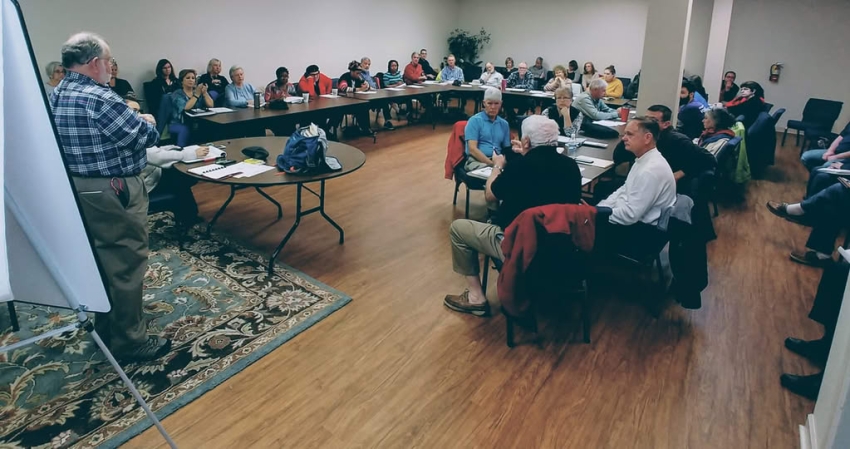
With initial funding, including a grant from Miami-Dade, the organization helped convene community leaders, nonprofits and agencies to answer one critical question: Who is going to do this work?
When the answer wasn’t clear, United Way stepped in to take the reins.
Two years later, Hurricane Florence brought widespread devastation across the region. But this time, something was different. United Way was ready.
They helped other counties stand up their own recovery groups, like Carteret Long-Term Recovery Alliance, while continuing to lead efforts in their own communities. What began as reactive relief had grown into a coordinated, regional system of recovery, including Craven and Pamlico Counties.
At the center of it all was something unprecedented: The Resource Table.
It was, in many ways, organized chaos but it worked.
Dozens of organizations including local nonprofits, state agencies and national partners sat around the same table.
Each case was presented, each need identified. And then, one by one, people spoke up:
“I’ll take the roof.”
“We’ll build the ramp.”
“We can handle that repair.”
For the first time, information was shared freely. Rebuild Groups shared their lists. The state shared theirs. Efforts weren’t duplicated. Resources weren’t wasted. And people, real people, got help faster.
United Way became the hub. The trusted connector. The place everyone turned to and asked, “Who’s doing the work here?”
And then there was Miss Mary.
She lived in Dover, in a home with a flat roof that had begun to fail. After the storm, she hired a contractor who took her money and disappeared. The leaks worsened. Mold spread. Eventually, she was forced out of her home, collecting water in buckets as conditions became unlivable.
She lost nearly everything.
But she never lost her patience.
For years, United Way through Coastal Carolina Disaster Resiliency Agency (CCDRA) and its partners worked her case coordinating volunteers, clearing out her home, advocating for resources. It wasn’t quick, and it wasn’t easy. But through persistence and partnership, Baptist on Mission eventually built her a new home.
Today, she loves where she lives.
Her story is just one of hundreds but it represents what disaster recovery truly means. Not just rebuilding homes, but restoring dignity, stability and hope.
Through every storm, one question has remained at the center of the work:
Who is going to do it?
And time and time again, United Way of Coastal Carolina has answered:
We will.
Because when disaster strikes, it’s not just about showing up, it’s about stepping up. Doing the hard, unglamorous work. Bringing people together when no one else can.
What started in the 90’s as a simple response has become a model of collaboration, trust, and leadership - one that continues to serve Eastern North Carolina today.
And in the face of every storm, past and future, one thing is certain:
They will be ready.